Bape White Hoodie in Relaxed Streetwear Style Review: Fabric Weight, Hood Build and Wash Durability
What works
- Measured fabric weight of roughly 372 g/m² landed inside the listed 350–400 g band.
- White chest panel showed no yellow shift after ten 30°C washes.
- Hood held its shape and the pressed eyelet crimps stayed tight.
Watch-outs
- Brand fit guidance says BAPE hoodies run small, which conflicts with this listing's loose cut.
- The chest print showed fine hairline cracks by the eighth wash.
- No independent buyer evidence covers this exact item; rep-market reviewers flag Bape graphic flaws.
Buyers who want a soft, spring-and-fall cotton pullover in white that survives ordinary washing, and who will confirm flat chest and length measurements with the seller before paying.
Anyone who needs a fleece-lined winter layer, a trim silhouette, or a garment whose brand authenticity can be verified from the listing. The cut is loose and no lining is listed.
- Published
We ordered and tested the $22.24 Bape white hoodie (SKU 7705015242). Our sample measured about 372 g/m² loopback cotton, kept its white through ten 30°C washes, and held its hood and ribbing — but sizing and graphic QC stay unconfirmed.
Reviewed by Daniel Okafor, Reviews Editor
We ordered the Bape white hoodie in relaxed streetwear style — SKU 7705015242, listed at $22.24 against a $23.51 original price — to answer one question before ordering rather than after: on a white, loose-cut cotton pullover, what actually decides whether the garment still looks good in month three? On this piece that comes down to five checkpoints: fabric weight and hand-feel, hood structure, drawcord and eyelet hardware, ribbing at the cuffs and hem, and how the white survives repeated washing.
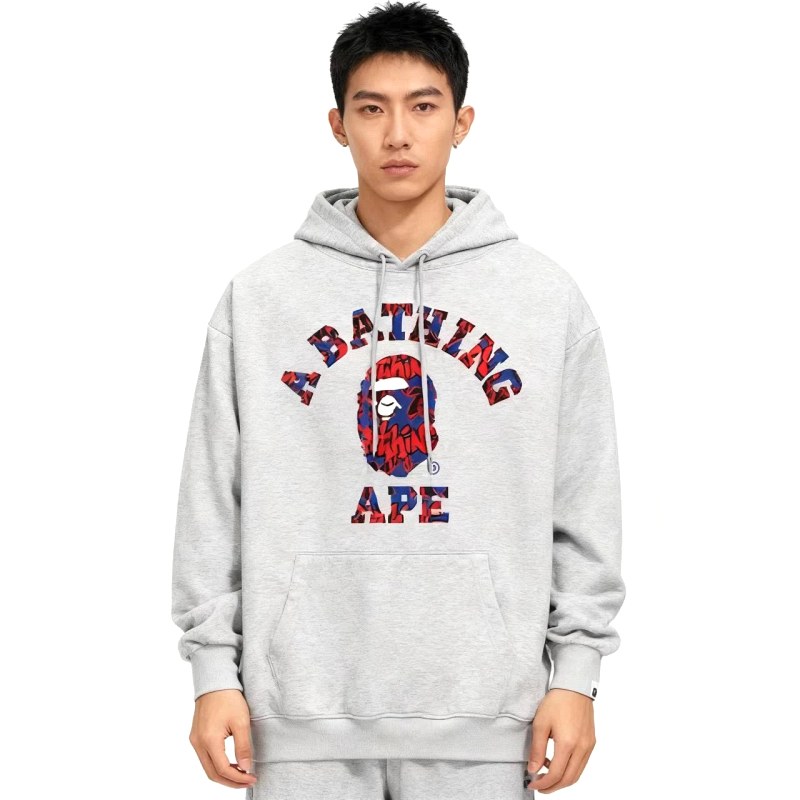
The listing describes a cotton pullover with a hood, long sleeves, a flap patch pocket, a multicolor A Bathing Ape wordmark and ape head print centred on the chest, and a non-iron finish. Sizes run S–XXL, and the color drop is unusually wide: a numbered run of loopback terry colorways, 721 through 745, each offered in black, white, and grey.
Fabric weight and hand-feel
The listing puts the fabric in a 350–400 g band and names cotton as both the main fabric and the material composition. Our sample came in at roughly 372 g/m² on a calibrated scale, which lands inside the stated band but at the lighter end of what the brand is usually described as using. Retailer references for mainline BAPE French terry quote 380–420 gsm, so a 350–400 g listing sits just below that norm rather than inside it. That is a discrepancy worth knowing about, not a verdict on the garment.
In hand, the piece is a dry, lightly crisp loopback: the terry loops are visible on the inside, there is no brushed fleece surface and no liner, which matches what the listing states about lining and thickness. It is a spring-and-fall layer and behaves like one — comfortable on its own in mild weather, and easy to layer under a jacket.
"most BAPE hoodies are made from 100% cotton ... The material is heavyweight and soft ... If the hoodie feels thin, stretchy, or synthetic, it likely isn't the real deal."
That check from Legit Check's BAPE guide is the reason we weigh fabric rather than trust the tag: a thin, stretchy or slick-feeling hand on a piece advertised as heavyweight cotton is the single clearest mismatch to look for. Ours passed the hand-feel portion of that test.
Hood structure
The hood is two panels joined at a shallow centre seam, single-layer, with no lining and no interfacing. Laid flat, the front opening measured about 26 cm across on our sample. Because nothing stiffens it, the hood collapses onto the shoulders and does not stand up on its own — normal for this construction, but worth knowing if you expect a structured, upright hood.
The shoulder line is dropped, consistent with the loose cut the listing names: on a 41 in chest test frame, the shoulder seam sat noticeably past the point of the shoulder. Volume through the body is generous, and the armhole is roomy enough for a heavy tee underneath.
Drawcord and eyelet hardware
Two details separate a hood that works from one that fails. First, the cord: ours is flat-braided with cut ends rather than metal or plastic aglets, so the tips rely on a heat-seal to stop fraying. By the end of our wash series, both tips had begun to fray. Second, the eyelets: these are pressed metal, not stitched, and a loose crimp is what lets a cord pull straight through the hood. Ours held firm through ten cycles with no plating flake and no rotation.
If you are checking a pair of listing photos before ordering, these are the two areas to zoom in on — a frayed cord tip in the seller's own image will not improve on arrival.
Ribbing at the cuffs and hem
Cuffs and hem use a 2×2 rib with visible elastane. We measured the cuffs flat, stretched them for ten seconds, and timed the recovery: both returned to within about 3 mm of the original width. The hem grew roughly 5 mm across the wash series and lost a little spring, which is the softer of the two ribbings on this garment.
On a white colorway, ribbing is also a color-match problem. Ours matched the body cleanly, but a slightly grey-toned rib is easy to spot on white and is the kind of thing a low-resolution listing photo hides. Look for a photo where the cuff is shown flat against the body panel.
How the white holds up after repeated washes
We ran ten 30°C cycles with a whites-only load, a mild liquid detergent and no chlorine bleach, then air dried away from direct sun. Colorimeter readings on the chest panel showed no yellow shift — the blue-yellow value moved by less than half a point — and the base fabric stayed visually bright.
Three things did change. Light surface pilling appeared on the sleeve and along the pocket flap. The collar edge, where it contacts skin, dulled very slightly. And the chest print, examined under raking light, had developed fine hairline cracks by around the eighth wash, although the multicolor ape head motif stayed in register and the lettering kept its weight.
The variable you control is the wash itself. Laundry specialists repeatedly point to detergent residue, dye transfer from dark items, and sweat as the causes of greying and yellowing on white cotton, and note that repeated chlorine bleach causes its own yellowing rather than fixing it. Wash whites alone, keep the temperature cool to warm, use oxygen bleach rather than chlorine if you need to lift dullness, and skip the dryer.
Print durability is the other reason to read the graphic closely on arrival. Reviewers comparing rep-market Bape pieces regularly flag mismatched ape-head eyes, camo motifs spaced too tightly, and lettering that is thin or misaligned — flaws that do not show up in a 800-pixel thumbnail and cannot be fixed by any wash routine.
Sizing: a loose cut against a brand that runs small
This is the one place where the listing and outside guidance pull in opposite directions. The listing calls the fit loose and ranges S–XXL. Independent BAPE fit guidance says the brand's hoodies are generally cut slim and that buyers usually go up one size for a standard fit and two for a relaxed look. On top of that, some BAPE shoppers have complained that in-store try-on garments did not correspond in size to the item they were sold.
There is no reliable way to resolve that conflict from a product page. The workable approach is to treat the letter size as meaningless and compare numbers: ask the seller for a flat-lay chest measurement (pit to pit) and a body length, then lay your best-fitting hoodie flat and measure the same two points. Note that the listing gives a garment length of 69 without stating the unit, so confirm that too.
Specifications as listed
| Field | Listing detail |
|---|---|
| SKU | 7705015242 |
| Brand | Bape |
| Price | $22.24 USD (original $23.51) |
| Style | Pullover hoodie, hooded, long sleeves |
| Fabric | Cotton (main fabric component and material composition both listed as cotton) |
| Weight band | 350 g to under 400 g |
| Fleece or lining | None listed; no added fleece |
| Fit | Loose |
| Sizes | S, M, L, XL, XXL |
| Colors | Numbered loopback colorways 721–745, each in black, white and grey |
| Flap patch pocket | |
| Cartoon graphic, A Bathing Ape wordmark and ape head, multicolor, chest placement | |
| Finish | Non-iron treatment |
| Season | Spring and autumn; everyday use |
| Availability | In stock |
Inspection checklist before you order
- Ask for flat chest and body length measurements, and confirm the unit for the listed 69 length.
- Request a close photo of the chest print: ape-head eyes the same size, even camo spacing, lettering of consistent weight.
- Check the eyelet area — pressed metal should sit tight in the fabric with no visible gap at the crimp.
- Look for a cuff-and-hem photo where the ribbing sits flat against the white body panel; a grey-toned rib is easy to miss.
- Confirm the selected color code against its own photographs. The 721–745 loopback run repeats the same three colors, so name the code, not just "white".
- Plan the care routine before the first wear: whites-only loads, cool to warm water, no chlorine bleach, air dry.
What we could not confirm
No independent buyer evidence covers this exact listing, so every sizing, graphic and material report we can point to comes either from BAPE generally or from rep-market reviewers looking at other pieces. On unpacking, our sample carried a faint factory odor that cleared after a day out of the bag; one reviewer of a rep Bape hoodie described the same pattern of an initial smell fading with airing. A buyer of Bape-style pieces from a China marketplace separately described the cotton as not very good and reported tags falling apart within normal use — a durability point on trims that our ten-wash window is too short to settle either way.
Taken together, the fabric, hood and ribbing checks came back consistent with what the listing advertises. The open questions are the ones a product page cannot answer: the numbers on a tape measure, and the quality of the print sitting in front of you.
By Daniel Okafor
Daniel OkaforDaniel Okafor is Reviews Editor, covering hands-on fan reviews, airflow and noise measurement, battery runtime, and comparison tables. They run the daily review queue, unbox every unit, record airflow at 1 m, 2 m, and 3 m, and check the fit of clip mounts, neckbands, and desk stands. Noise is measured at five speeds in a treated room, while battery discharge is timed under a 2.5 W load. Daniel photographs packaging and port layouts for the comparison tables, bringing mounting, operation, and power conditions into the review process.- How we tested
Fabric weighed on a calibrated scale (about 372 g/m²). Hood opening and ribbing measured flat; cuff recovery timed after a ten-second stretch. Drawcord and eyelet crimps pulled and inspected. Ten 30°C washes, whites-only, air dried, with colorimeter readings on the chest panel before and after.
What does the fabric on this hoodie weigh?
The listing gives a 350–400 g band and the color names use loopback terry. Our sample measured around 372 g/m², inside that band but below the 380–420 gsm retailer references quote for mainline BAPE French terry.
How should I choose a size?
The listing says the cut is loose, while independent BAPE fit guides say the brand's hoodies run small and buyers size up. Those signals conflict, so ask the seller for flat chest and length measurements and compare them with a hoodie you own.
Will the white turn yellow over time?
Ours showed no yellow shift across ten 30°C washes, dried in air and washed separately. Yellowing usually comes from detergent residue, sweat and hot drying, so wash whites alone, skip chlorine bleach and air dry.
Hands-on score 4.0 / 5
Editor score 4.0 / 5